


The Church of Jesus Christ is strengthening its sustainability initiatives in Mexico, including water and energy conservation and reforestation
As part of its commitment to caring for the earth and using resources responsibly, The Church of Jesus Christ of Latter-day Saints continues to implement sustainability initiatives around the world. These efforts help reduce energy and water consumption, reduce the environmental impact of its properties and generate long-term savings.

This meetinghouse of The Church of Jesus Christ of Latter-day Saints in Acapulco, Mexico, is an example of solar panels creating electricity for lighting, air conditioning and other services.
In Mexico, the Church is advancing four main areas of action:
- Installing solar panels at meetinghouses to convert sunlight into electricity for lighting, air conditioning and other services.
- Implementing low-water landscaping using native or drought-resistant vegetation.
- Developing permeable parking lots that allow rainwater to filter into the ground.
- Carrying out reforestation programs that help clean the air and improve the environment.
Alberto de Hoyos, operations and maintenance manager for the Church in Mexico, said these initiatives “seek to reduce environmental impact and optimize operational resources, while promoting a culture of caring for the planet among leaders and members of the Church.”
“The Church’s commitment to caring for the planet is reflected in concrete actions aimed at using resources more wisely and showing gratitude for God’s creations,” he added.
Energy: Progress on Rooftop Solar Systems
To date, solar panels have been installed at over 50 meetinghouses across the country. This effort is expected to reduce electricity consumption at each site by nearly 90%, while generating substantial cost savings. In addition, these projects reduce demand on the local electricity grid.
The recent installation of approximately 3,100 solar panels will prevent about 1,240 tons of carbon dioxide from being emitted each year.
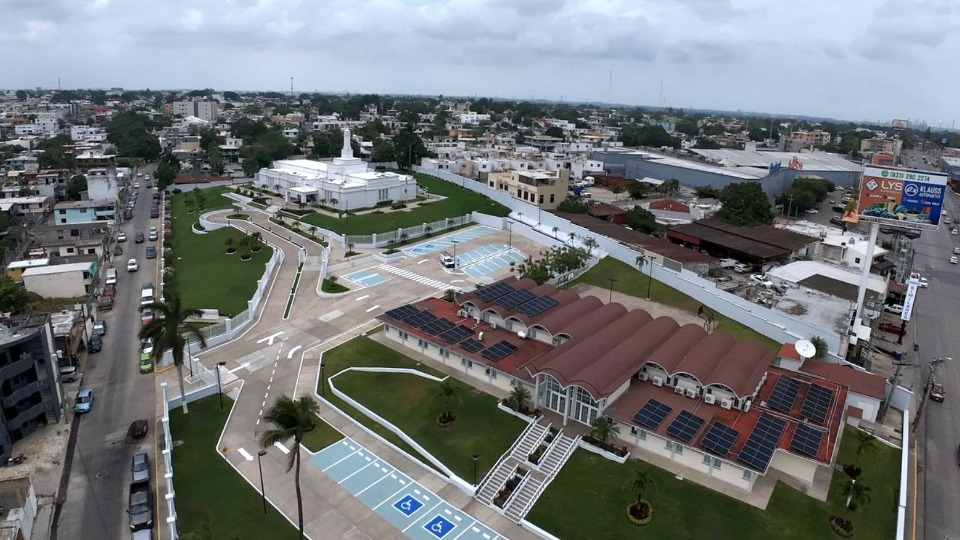
A meetinghouse of The Church of Jesus Christ of Latter-day Saints in Madero, Mexico, with solar panels adjacent to the Tampico Mexico Temple.
Water: Conservation and Responsible Use
In water management, the Church promotes a comprehensive, sustainable landscaping strategy that includes adapting meetinghouses to local conditions. In water-stressed communities, this means reducing grass areas and replacing them with low-water vegetation, using ground cover and alternative materials that require less irrigation, and evaluating rainwater capture and reuse systems.
These actions contribute to a significant reduction in water consumption and more efficient property management.

This meetinghouse of The Church of Jesus Christ of Latter-day Saints in Puebla, Mexico, is an example of sustainable landscaping.
Reforestation and Environmental Restoration
The Church has also advanced reforestation initiatives by planting trees and native vegetation adapted to each region. These efforts help reduce heat, improve local air quality, capture carbon, improve groundwater infiltration and strengthen local ecosystems.
Infrastructure improvements include permeable pavement in parking lots, allowing rainwater to return to the ground. These solutions reduce water waste, support aquifer recharge and help lower heat retention.
A key component of these efforts is involving Church members and leaders through training and consistent communication that encourages caring for the earth as part of responsible stewardship.

This meetinghouse of The Church of Jesus Christ of Latter-day Saints in Puebla, Mexico, is an example of sustainable landscaping.
Mexico Missionary Training Center: A Model in Action
The Mexico Missionary Training Center (MTC) shows how these initiatives are implemented comprehensively.
Located on a nearly 89-acre campus — 54 acres of which are green space — the MTC has undertaken several recent projects. In the past five years, nearly 200 trees have been planted, including jacarandas, oaks and olive trees, selected according to local environmental regulations. These trees help generate oxygen, capture carbon and maintain ecological balance.

The Missionary Training Center in Mexico City of The Church of Jesus Christ of Latter-day Saints implements sustainability efforts comprehensively.
In terms of solar energy, the MTC includes 50 residences, each housing up to 26 missionaries, equipped with solar collectors that heat about 80% of the water used. This technology has also reduced annual gas consumption by approximately 80%.
For water management, the MTC operates a treatment plant with a daily capacity of more than 92,000 gallons, serving up to 2,500 people. It currently processes between 26,000 and 32,000 gallons per day, depending on occupancy levels.
Treated water is used to irrigate green areas — currently about 30% of irrigation needs — with potential to increase as facility use grows, including future use for the Mexico City Benemérito Temple.

In the past five years, nearly 200 trees have been planted at the Mexico Missionary Training Center of The Church of Jesus Christ of Latter-day Saints, including jacarandas, oaks and olive trees.
The MTC also has a rainwater harvesting system with a capacity of nearly 120,000 gallons, supporting long-term sustainable water use.
Overall, the MTC’s sustainability projects prevent approximately 2,230 tons of carbon dioxide emissions annually.
“These actions reflect a comprehensive vision of sustainability that combines environmental responsibility, efficient resource use and community commitment,” de Hoyos said.
Through these efforts, the Church in Mexico continues to move toward a more responsible development model, in harmony with the environment and focused on preserving the planet for future generations.
